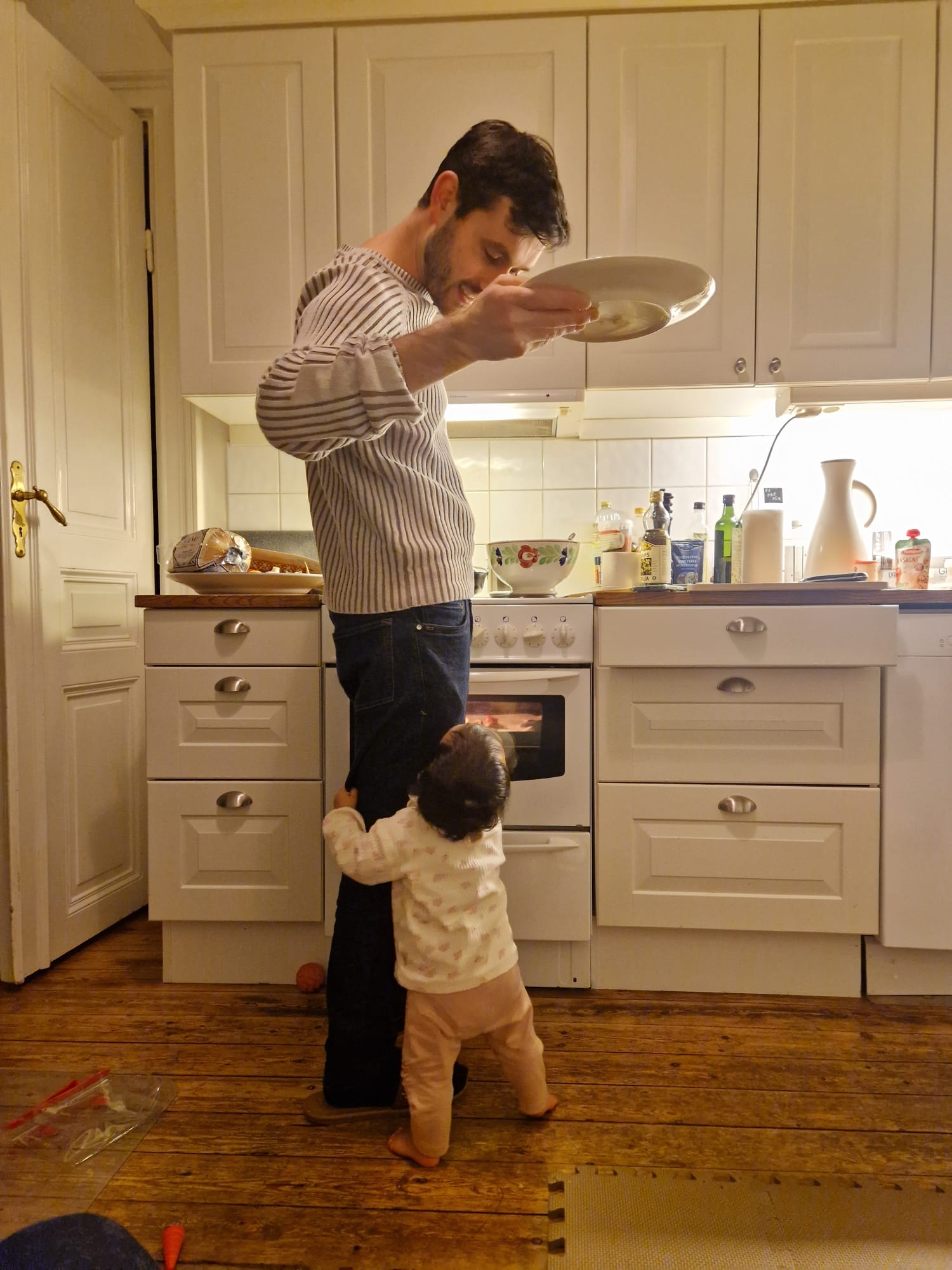
This post is a bit different. I wrote this during paternity leave, and edited it after going back to the office.
I’m back at work after 3 months of paternity leave. This is the longest I’ve been away from work since I was seventeen. (It was long enough that I stopped checking Slack every day.)
During my leave, besides taking care of my daughter, I had some time to read. One book I read was The Disappearance of Rituals by Byon Chul Han. In the book, Han writes how modern life has eliminated our capacity to dwell or linger, and to do things without producing or optimizing.
I wanted to read this book, because I want to give my daughter a life that is filled with culture, and belonging. And my thinking is that rituals create belonging. So I read it, and it was great. Here are some things I took away from reading Disappearance of Rituals during this time:
1. Consumption and production often are different sides of the same coin
Even in this time without work, stress finds its way in. Stressful events happen. Moments of anxiety about the future, about money, about whether I’m making the right decisions. But in this paternity life, its easier to notice the stress and reflect on it, instead of only being affected by it. So, I noticed something about my own automatic responses to stress.
First thing that happens: my brain tells me to buy something. New sneakers, or nice pants, or a running cap. Retail therapy. The promise that consumption, or something new, will soothe the discomfort. I catch myself in this thought and wonder: why am I so conditioned to believe that purchasing something will make me feel better?
But then comes the second response, the one that feels more virtuous: Maybe instead of consuming something, I should create something. Write a blog post. Start a project. Make art. This feels better, more meaningful than mindless consumption.
Here’s what’s interesting though: both responses are preprogrammed. Both are conditioned reflexes of living in what Han calls “achievement society.” We’ve been trained to believe that consumption brings pleasure and relief, and that production brings meaning and virtue. But what if these are two sides of the same coin? What if both are just ways of avoiding something deeper — the simple act of sitting with discomfort, of being present with what is?
2. Running as ritual
I started running more seriously earlier this year. And I immediately turned it into an optimization project. At each run I had a goal, like: run one kilometer further than last week. Or: run the same distance but faster. So I was tracking my pace. Every run was evaluated against the previous one, never good enough in itself, always a means toward a better version.
Then I read Han’s book, and I thought, what if I just run as a ritual? I can still bring my sportswatch and measure my speed, but I will not look at it midrun, and I will not try to improve my pace.
So I run the same distance every time now. I don’t check my pace during the run. I just run because the run itself has meaning, not because it’s producing anything.
The first time I did this felt really great. It actually felt like freedom, freedom from my own expectations. And I think this is what Han means. Rituals are about repetition, not improvement, and they create rhythm in your life.
3. The disorientation of unstructured time
One unexpected effect of being home for so long is that weekends have lost some of their meaning. When I was going to the office five days a week, weekends were important. When I was home all week with my daughter, Saturday and Sunday felt the same as Tuesday.
Han writes that rituals are to time what a home is to space. They’re not just arbitrary habits — they structure time, create thresholds and transitions, tell you where you are (in time). The five-day work week creates a rhythm: Monday is beginning, Wednesday is midpoint, Friday is release, weekend is freedom.
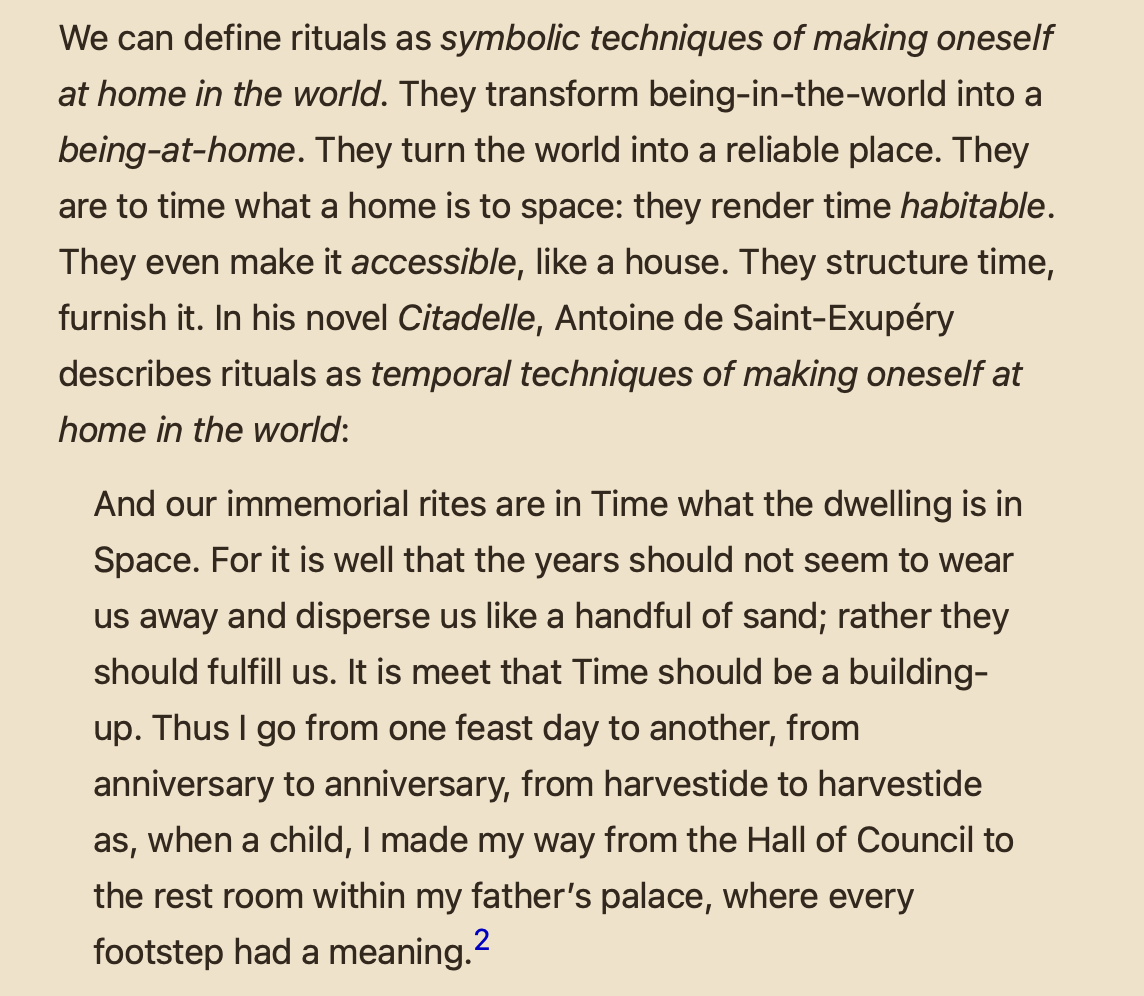
Without that structure, time becomes amorphous. The days blur together. I was experiencing what Han might call “the crisis of time” — when time loses its articulation, its shape.
But is the work week actually a ritual in Han’s sense? Or is it just capitalist time discipline? Han distinguishes between rituals — symbolic repetitions that create meaning and community — and routines, which are empty repetitions in service of productivity. The work week is more routine than ritual. It structures time, yes, but toward production, not meaning.
What I was experiencing might actually be closer to genuine ritual time: the repetitive, cyclical care of an infant. This is more ancient, more fundamental than the work week.
Back at work
This week I went back to the office. My wife is home with the little one now, and later this month she will start preschool.
I don’t know if and when I will be off work for so long again. I like to work. I enjoy it. I want to tackle hard problems. But this period of paternity leave was great, and I am grateful for the Swedish system, with its generous parental leave.